
Dr Rosa Vidal Doval
Lecturer in Spanish
Dr Rosa Vidal Doval is a Lecturer in Spanish at St Edmund Hall.
Rosa was educated in Spain and Eswatini, before reading for a BA in Medieval Studies at the University of Manchester. She also completed an MA in Medieval History and a PhD on religious persecution in fifteenth-century Spain at Manchester. She taught at Merton College, Oxford (2005–6), the University of Liverpool (2006), Aberystwyth University (2006–7), and Queen Mary, University of London (2007–23) before joining St Edmund Hall in 2023. She is also Tutorial Fellow in Spanish at Magdalen College and Associate Professor of Medieval Iberian History at the Faculty of Medieval and Modern Languages.
Rosa works on the culture and history of late medieval and Renaissance Iberia. She is particularly interested in the phenomenon of religious conversion and in the role of texts in fomenting and sustaining religious intolerance, chiefly with regard to converts from Judaism to Christianity (conversos).
She is currently working on two main projects. Firstly, a monograph (Purity of Blood in Late Medieval and Early Modern Spain: Genealogy, Discrimination, and Race), charting the creation of a racialised system of religious exclusion (limpieza de sangre) that turned doubts about the bona fides of converts from Judaism and Islam into an inherited defect carried in the body of the believer. Secondly, with Anthony J. Lappin (Stockholms universitet), the first modern edition and English translation of Alonso de Espina’s Fortalitium fidei (1464).
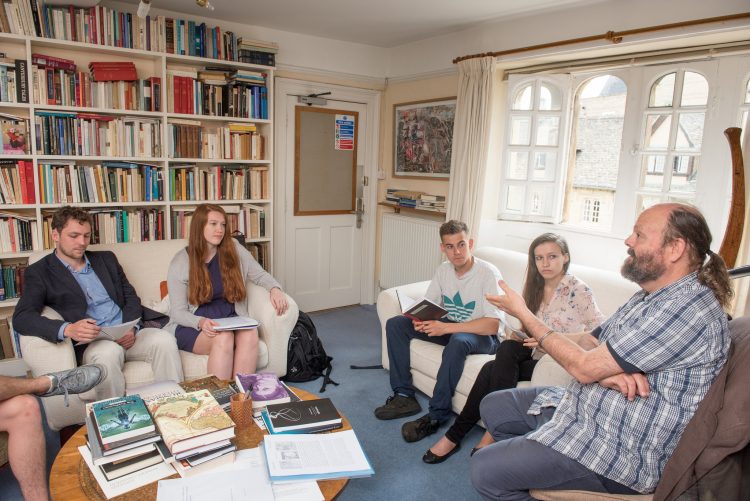
Rosa teaches the Spanish Prelims (first year) course and translation from contemporary Spanish to Final Honours School (second and final year) students at St Edmund Hall. She also teaches Medieval literature, culture, and translation options (Papers VI, IX, and III).
‘Conversion as Education: Persuading the Jews in Juan Luis Vives’s De veritate fidei christianae’, Medieval Encounters, 31.1 (2025), 26–46.
With Anthony Lappin, ‘Experience, Authorship, Judicious Silence: Alonso de Espina’s Fortalitium fidei’, in ‘Experientia ut magistra docet’: Cristianesimo e islam nel quattrocento, ed. by Davide Scotto (= Rivista storica italiana, 137.1, (2025)), 338–63.
‘St Paul, the Apostolic Age, and the Status of Conversos in Alonso de Espina’s Fortalitium fidei (1464) and Hernando de Talavera’s Católica impugnación (1480)’, What is Converso Paulinisms?, ed. by Claude B. Stuczynski and Yosi Yisraeli (= Hispania Judaica Bulletin, 15 (2024)), 63–80.
‘Discernment of Spirits and Spiritual Authority: Tractatus de vita spirituali and Its Afterlife’, in Gender and Exemplarity in Medieval and Early Modern Spain, ed. by María Morrás, Rebeca Sanmartín Bastida and Yonsoo Kim, The Medieval and Early Modern Iberian World, 79 (Leiden: Brill, 2020), pp. 112–35.
‘“Qui ex Iudeis sunt”: Visigothic Law and the Discrimination against conversos in Late Medieval Spain’, in Forced Conversion in Christianity, Judaism and Islam: Coercion and Faith in Pre-Modern Iberia and Beyond, ed. by Mercedes García-Arenal and Yonatan Glazier-Eytan, Numen, 164 (Leiden: Brill, 2020), pp. 60–85.
‘Misera Hispania’: Jews and ‘Conversos’ in Alonso de Espina’s ‘Fortalitium fidei’, Medium Aevum Monographs, 31 (Oxford: The Society for the Study of Medieval Languages and Literature, 2013).
‘“Nos soli sumus christiani”: Conversos in the Texts of the Toledo Rebellion of 1449’, in Medieval Hispanic Studies in Memory of Alan Deyermond, ed. by Andrew M. Beresford, Louise M. Haywood, and Julian Weiss (Woodbridge: Tamesis, 2013), pp. 215–36.
Hacia una poética del sermón, ed. with Rebeca Sanmartín Bastida and Barry Taylor (= Revista de poética medieval, 24 (2010)).
Las metamorfosis de la alegoría: discurso y sociedad en la Península Ibérica desde la Edad Media hasta la Edad Contemporánea, ed. with Rebeca Sanmartín Bastida (Frankfurt am Main: Vervuert; Iberoamericana: Madrid, 2005).
Where next?
Spanish