
Bears of St Edmund Hall: An Exhibition for Community and Giving Week 2026
18 Mar 2026|James Howarth
- Library, Arts & Archives
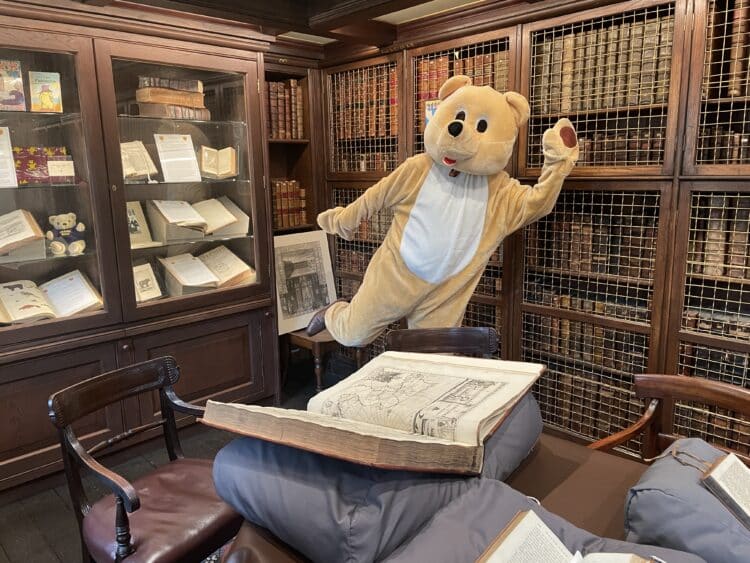
If you went down to the Old Library a few weeks ago you would have been sure of a big surprise: to celebrate Community and Giving Week 2026 we put on an exhibition celebrating bears from the Hall’s archives and collection of historic books. There wasn’t quite ‘every bear that ever there was’, but here are some highlights.
1. Teddy Bears at Teddy Hall
St Edmund Hall has been familiarly and affectionately known as ‘Teddy Hall’ or ‘Teddy’ for at least 150 years. The earliest known mention is in a bill for the stained glass in the east window of the Chapel from 1865. Once the teddy bear – named for US President Teddy Roosevelt – came into popularity in first decade of the 20th century it was perhaps inevitable that Teddy Hall teddy bears would come into existence.
The first extant reference is for a dining club, the Teddy Bear Society, from which a menu (signed by members) survives from 11 June 1920. That evening, the society dined on salmon, roast lamb and ice cream amongst other dishes. A reference in the 1920 Hall Magazine notes “the various Year Clubs which dominate our social activities: ‘ The Owls,’ ‘ The Glow Worms,’ ‘The Choughs,’ ‘The Martlets’ and ‘The Teddy Bears.’”
For many years the College Cricket second team was known as ‘The Teddy Bears’ who brought an enthusiasm to both the game and to celebration that outstripped their sporting skill. The fixture list for 1948 finds them playing village cricket teams from across Oxfordshire, giving an opportunity to slip the bounds of the more strait-laced city. The club sported a distinctive tie decorated with Teddy bears, one of which was given to Prince Phillip in 1957 when he presented the Hall with the Royal Charter establishing it as a full College in the University. Prince Philip accepted “on the condition he did not need to undergo the qualifying rites” according to the Hall Magazine.
In the 1960s there are passing mentions of a Hall teddy bear, normally to be found in the company of Mrs Buckett, a long serving and much-loved College Scout. They accompanied the Hall team to a recording of University Challenge in 1966 and are pictured here alongside the Hilarians (the Rugby Club’s second team) mourning the demolition of ‘the Orient’, an outside lavatory and washing block formerly behind the Chapel, in 1967.
In the 1990s the Hall marketed a range of teddy bear-themed merchandise including ties, playing cards, tea cosies and handkerchiefs. This apron is the only example still in College possession.
2. A gallery of bears at play; advertising the Hall Ball in the 1970s
The Hall Ball is always a raucous riotous and joyful occasion. For the exhibition a splash of colour was brought to the austere Old Library with a collection of posters for Balls past.
During the 1970s a succession of Balls were advertised, with scant regard for copyright and intellectual property but with some verve, using famous bears (including Baloo, Paddington, Rupert and Winne-the-Pooh). Other years the bears were less renowned but equally colourful (a rather worse-for-wear black-tie bear in 1972, picnicking bears in 1973 and a medieval dancing bear in 1976).
Although this year’s Hall Ball on 2 May does not promise any bears, a good time is sure to be had and tickets are still available.
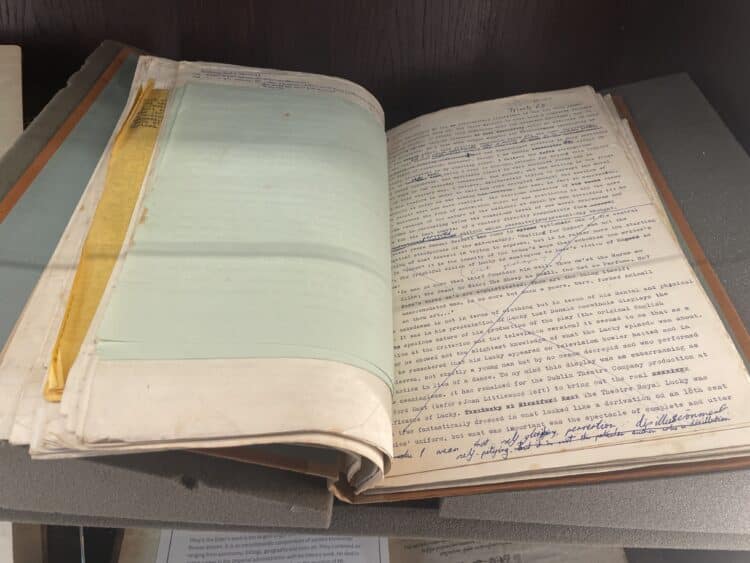
3. A bear of ‘very little brain’ but much immorality? Terry Jones on Winne-the-Pooh
Satire, parody, even flat-out absurdity have long played a significant part in student humour in Oxford. Societies and clubs dedicated to making fun of anything or even everything have flourished throughout the University’s history. In this piece, Terry Jones (mat. 1961) adopts the form of a censorious academic essay, to reveal ‘the most perverting writer’ to be AA Milne the author of Winnie-the-Pooh. It appears in a book published by the Hall’s ‘Makers Society,’ represented as an essay society meeting regularly to review each other’s work. We have to say we are not sure if this society actually existed as a, presumably humorous, club or is itself part of the satirical intention of the book’s five authors.
An earlier version of the essay was read to the Hall’s Essay Society in 1962. The Hall Magazine that year reports: “We were jerked out of our complacency by Mr. T. G. P. Jones’ revelation of the character who was responsible for today’s ‘Writers of lmmorality’-Winnie the Pooh, assisted by a megalomaniac Rabbit and that self-dramatising social failure, Eeyore.”
The draft of the essay, complete with many crossing out and slips of paper replacing passages, survives in the Society’s records held in the College archives.
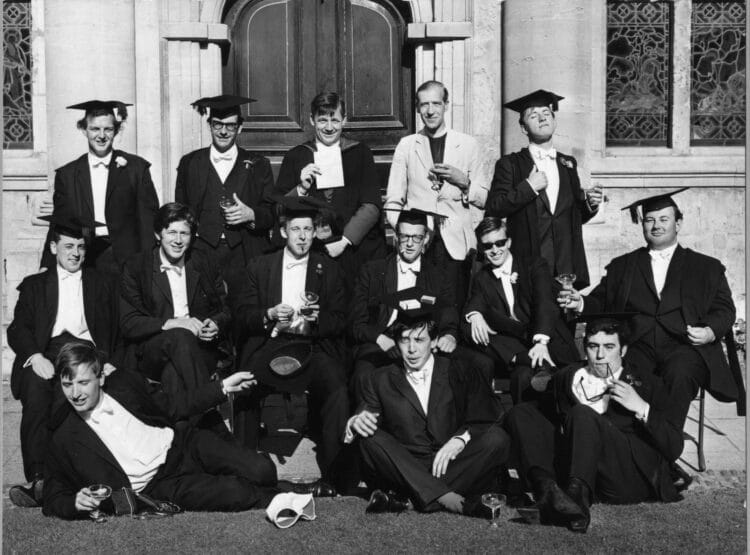
Terry Jones read English at Teddy Hall. He is pictured here (bottom right) with his fellow students after the completion of his Finals in 1964. Terry went on to become famous as part of the Monty Python team. He was a multi award-winning comedian, actor, film director, documentary maker, distinguished scholar of the middle ages, author of beloved children’s stories, librettist, political commentator and much more besides; most importantly for us, an Aularian and Honorary Fellow of the Hall.
4. Beowulf: An Old English Bear with Aularian connections
Beowulf is the great surviving epic of Old English verse, telling the story of a hero and his fights against a series of monsters. Some scholars have interpreted the name of the hero as ‘bee-wolf’ and argued it is a poetic kenning or figure of speech for ‘bear’. A cognate figure in Norse legends, Bödvar Bjarki, has the ability to shape-shift into a bear.
The poem owes its first appearance in print to an alumnus of Teddy Hall.
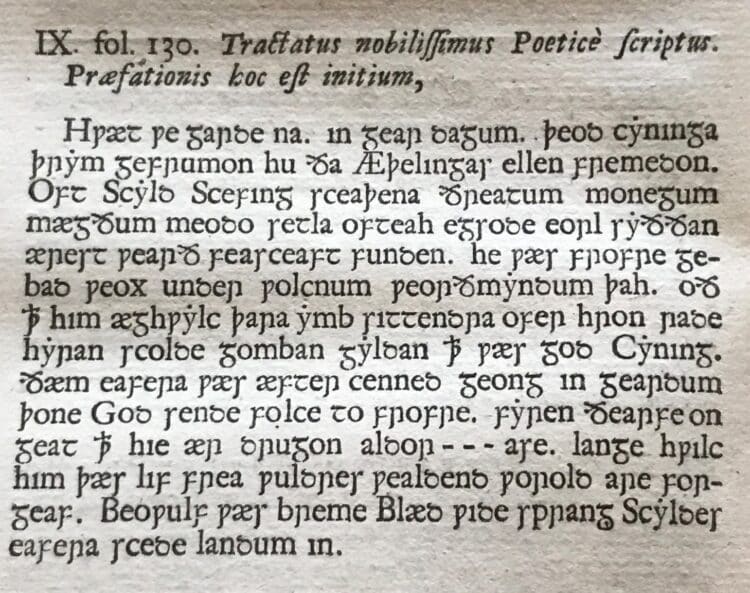
Humfrey Wanley (1672-1726) was the son of a Coventry clergyman. He was initially apprenticed to a linen draper, but having taught himself Old English from a copy he made of George Hickes’ Institutiones grammaticæ, he came to Oxford in 1695.
He was briefly resident at St Edmund Hall before moving to University College and becoming an assistant at the Bodleian Library. He collaborated closely with George Hickes on the whole text of his Linguarum veterum septentrionalium thesaurus grammatico-criticus et archaeologicus (Oxford, 1705), a massively expanded version of Hickes’ earlier work. Subsequently the two fell out, with Wanley feeling that the £60 he was paid for his work on the Thesaurus did not reflect his contribution. The second volume is ascribed on its title page to solely to Wanley. It forms a catalogue of all Old English manuscripts that were known at the time and remained the most comprehensive account until well into the twentieth century.
The copy of the catalogue on display is open on the entry for Cotton MS Vitellius A. xv, the manuscript which contains Beowulf and includes the opening of the poem. This was the first time that any of the text of Beowulf was printed.
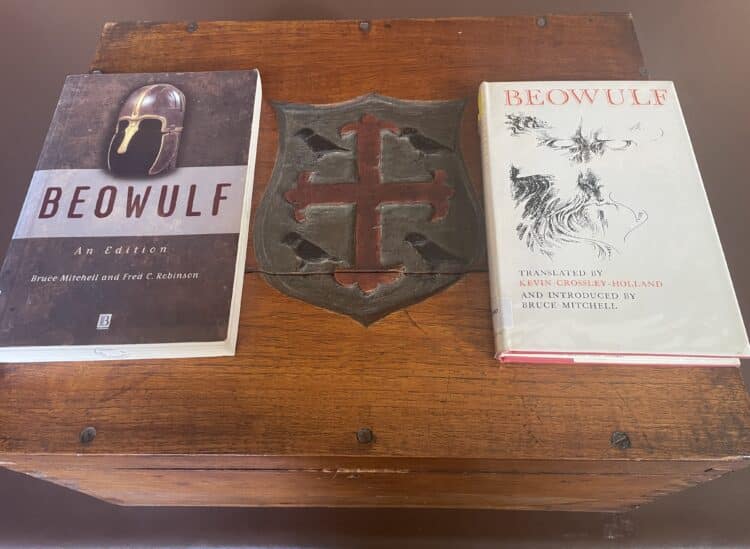
Bruce Mitchell was a beloved English Fellow and Tutor at St Edmund Hall for over 30 years, from 1955 to 1987. An internationally reputed scholar of Old English Language and Literature, his Guide to Old English has been for many years the main textbook on the subject for undergraduates. In 1998, along with the scholar Fred Robinson, he published an edition of Beowulf.
Kevin Crossley-Holland, a Hall alumnus and pupil of Bruce, collaborated with him a translation of Beowulf. Kevin is a prize-winning poet, translator from Anglo Saxon, re-teller of traditional tale, librettist and novelist for children.
Another of Bruce’s pupils, the sculptor Rodney Munday, deals in this drawing with a textual crux in Beowulf. Rodney also created the statue of St Edmund which sits in the graveyard of St Peter-in-the-East, now the College Library.
![Woodcut of Elisha and the bears from Biblie sacre textus, cu[m] concorda[n]tijs Veteris ac Noui Testame[n]ti (Lyon, 1531) Shelfmark22. MM 141](/asset/21.-MM141-smartphone.jpg "21. MM141")
5. Biblical Bears: “Go away, baldy!”
Two bears make their presence strongly felt in a curious story in the Second Book of Kings in the Old Testament. The Prophet Elisha is travelling to the town of Bethel, when he is accosted by a group of children who mock him for his baldness. He curses them, whereupon two she bears appear out of the woods and maul 42 of the children.
“And he went up from thence unto Beth-el: and as he was going up by the way, there came forth little children out of the city, and mocked him, and said unto him, Go up, thou bald head; go up, thou bald head. And he turned back, and looked on them, and cursed them in the name of the Lord. And there came forth two she bears out of the wood, and tare forty and two children of them.” (2 Kings 2:23-4)
Unsurprisingly, this scene proved popular with illustrators as can be seen in two of our most beautiful bibles.
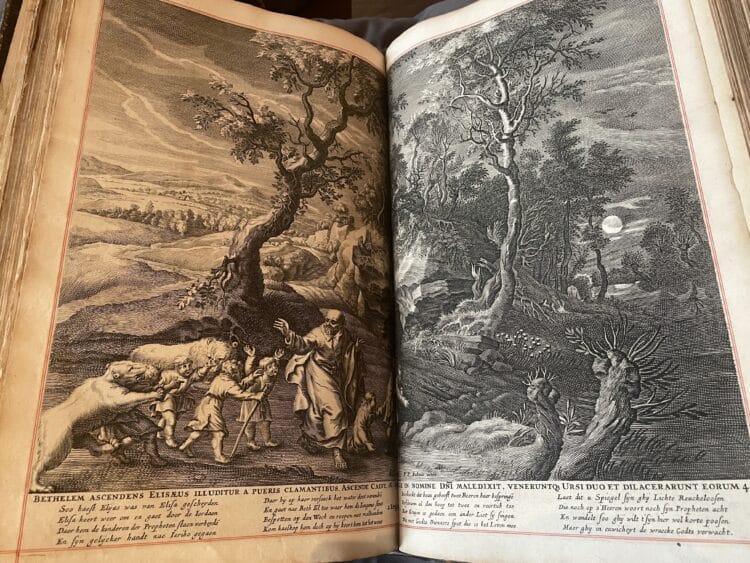
The oldest Bible in the Library’s collection was printed in 1531 in Lyons. In many ways it looks back to the Middle Ages rather than the tumult of the Reformation which was shaking Europe at the time. It prints the Vulgate text, the Latin translation of the Bible produced by St Jerome in the 4th century and intricate tiny woodcuts illustrate the start of significant episodes.
William Glynne (mat. 1679) gave £10 towards the building of the Chapel and Old Library, but also, in 1681, this two-volume Bible for use in the Chapel. It is lavishly illustrated with nearly a hundred engraved plates of scenes from the Old and New Testaments in a Baroque style. The colourful donor inscription complete with the Glynne family arms is the most elaborate in the collection in the Old Library. The Benefactor’s Book values the Bible at £10, the equivalent to at least £1400, and probably much more, today. It will have been used in the service to consecrate the Chapel on 7 April 1682.
6. Finally, some ornamental bears
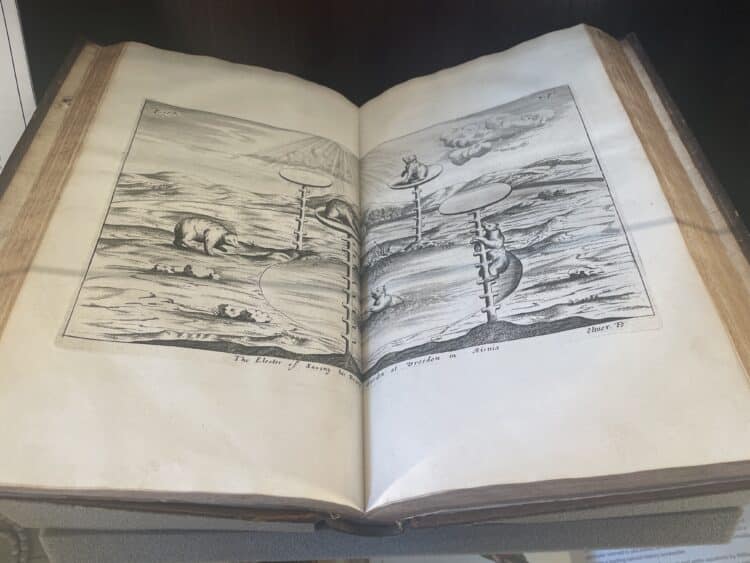
Edward Brown (1644-1708), was a physician by training but had a wide range of intellectual interests. His account of his various travels around Europe not only include sites such as the Elector of Saxony’s bear Garden in Dresden pictured here or the amphitheatre at Verona but also detailed accounts and diagrams of mines in Hungary and Austria.
Although Brown notes that Dresden “was but lately a village” he describes many notable places to see, including the bear garden:
“In the Hunting-house, in the old Town, are fifteen Bears very well provided for and looked unto. They have Fountains and Ponds to wash themselves in, wherein they much delight : And near to the Pond are high ragged Posts or Trees set up for the Bears to climb up, and Scaffolds made at the top to sun and dry themselves; where they will also sleep, and come and go as the Кeeper calls them.”
This small silver bear is a Hall mystery. His age and provenance are unknown, as is how long it has been in the College’s possession. The bear was discovered by Jonathan Yates, the Chattels and Picture Fellow, at the back of the silver safe during an inventory. At formal and celebratory dinners, he is now proudly displayed on High table along with rest of the Hall’s silver collection.
Edmund Bear with his distinctive blue guernsey sweater has been an icon of Teddy Hall since the 1990s. Much loved by Aularians past and present, he has travelled around the world and can also be found in offices and other spaces across College, including the Library where he superintends the new book display on the old card catalogue. He is honoured to be the star of Community & Giving week 2026 and you see more his adventures last week here.
Category: Library, Arts & Archives
Author

James
Howarth
James has been St Edmund Hall’s Librarian since May 2018. He is responsible for maintaining and developing the library’s collections – including the historic and special collections that are housed in the seventeenth-century Old Library and is keen to promote their use in research, study and outreach.