
Why does the world need an AI Oath?
9 Jun 2026|Lyndon Drake
- Research
The Venerable Dr Lyndon Drake explores the moral and theological implications of an AI Oath. Alongside his roles as Chaplain and Senior Research Fellow at St Edmund Hall, Dr Drake is a Research Fellow in AI at the Ian Ramsey Centre for Science and Religion within Oxford’s Faculty of Theology and Religion. His current work focuses on developing an Oxford AI Oath, modelled on the Hippocratic Oath, to provide an ethical framework for humanity’s use of artificial intelligence.
We recently spoke with Dr Drake as part of our social media video series highlighting the latest research from members of the St Edmund Hall community.
What is the Oxford AI Oath?
Members of the Faculty of Theology and Religion were approached by people in industry looking for ethical guidance on their work in AI. The idea of an oath came up and has been proposed, for example, by Mustafa Suleyman, Co-Founder of DeepMind, as a way of providing boundaries for the moral reasoning of people working in AI. And so we decided to work together on coming up with an oath similar to the Hippocratic Oath that would be useful across a wide range of people, whether they’re religious or not, but explicitly working from theological reasoning and theological moral ideas.
What does theology have to do with artificial intelligence?
At first, it might not seem at all obvious what theology has to do with artificial intelligence. Artificial intelligence is new; theology is very old. But it turns out that some of the questions that have come up in recent years around artificial intelligence are actually very old questions and theology has a lot to say about them. For example, questions around language and whether language has a true meaning behind it or not.
I’ll give you just one example where there’s a constructive contribution from theology to our understanding of AI tools and systems. In the Middle Ages, theologians had the insight that when we use a tool, it also changes us. And that can be seen both constructively or as a loss. And we can apply this thinking to AI tools. When we use them, they’re also changing us and the ways they affect us are complex. So we take this and other examples as ways in which theology can be in conversation with AI science and engineering.
How do you implement an Oath for AI?
We’re doing the Oxford Oath for AI implementation in a couple of phases. After feedback from people in industry, we’ve realised that an open letter was a good way of engaging a wide range of people and let us say something quite substantive about AI. So we’ve put that out for people to sign up to. And we’re also taking a period of some months to reflect and engage on the oath itself before we try and form a fellowship of those who’ve professed the oath. And that’s because an oath is meant to be something very long-lasting. Think of the Hippocratic Oath, which has lasted for many centuries. And so, we want to take our time before taking that step with the oath. In the meantime, the open letter is available for people to sign up to.
What is the impact of your research?
A lot of AI work is undertaken by people who have limited agency. So in other words, the vast majority of people who work in AI are not industry leaders, nor are they in charge of government, but they still have to make moral and ethical decisions about their daily work. Our work is intended to impact on the wide range of people who are working in AI practice. And at the same time it intends to generate an ethos, I suppose in some ways bottom up, and helps to orient the moral deliberation of the whole of society.
Category: Research
Author
Lyndon
Drake
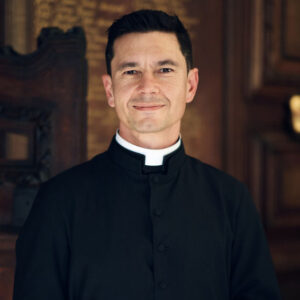
The Venerable Dr Lyndon Drake joined the Hall in 2026 as College Chaplain and Senior Research Fellow.